Nov 30 2024

Ghost Engineers: The Latest Bullshit Moral Panic

Hot off the presses the week while the US celebrated Thanksgiving, we’ve got a new report that a Stanford researcher has found that as much as 10% of software engineers may be “ghost engineers” who are allegedly around 10% as productive as the median engineer. In other words, this researcher claims to have discovered the corollary to the mythical “10x engineer”.

And executives love to eat this shit up. They love this kind of boogeyman that is leeching company value and they love having something that looks like hard data backing this up, because executives love to come off as being data driven (except, you know, when they’re not).

It doesn’t take much digging to realize the researcher here has produced a more convoluted version of how dumbass managers in the 80s tried measuring developer productivity by lines of code written. The methodology in this research involved taking Git repositories and analyzing the code written to see how many changes developers were making, and it attempted to compensate for things like small changes that were of some complexity (it’s unclear whether AI-based tools actually can do that, but whatever). Even if you assume it’s perfect at this, the entire methodology hinges on the assumption that the only thing of value that developers can do is write and change code.

And get this: there are other important ways engineers contribute to a company’s success that aren’t writing code! 🤯

Some engineers benefit their team by being catalysts. They may not specifically be prolific by writing a bunch of code themselves, but instead they produce ripple effects throughout their team. They’re writing up documents and starting discussions about important big swings. They’re mentoring more junior members of their team. They’re reviewing pull requests and providing feedback. They have these serendipitous conversations with people, making connections between different teams and kicking off really useful relationships.

They may accomplish a week’s worth of work in a one-hour pairing session by getting a colleague on the right track or unblocked from a vexing issue.

And if you’re sitting there like a dipshit counting their pull requests and noticing that the number is smaller than the number of other engineers’ pull requests and thinking that counts as meaningful analysis, you might miss that.

If you want to build a team worth a shit, you fill it with people with different strengths. That engineer that’s always cranking out pull requests is awesome, but if you look more closely you’ll see that engineer looks productive because they set aside tasks that look too deep or complex.

But that’s not a problem if you have another engineer who doesn’t crank out nearly as many pull requests, but instead finds those issues that got passed around by half a dozen other engineers on the team over the past two months and then do a deep dive into it, spending weeks to eventually solve a complex problem that is deeply impactful to have solved.

Your engineering team should have a big enough variety of engineers that the ones producing the most code produce a large factor more code than the ones who produce the least, and you should have variance like that among all the other kinds of characteristics you can imagine. But the one area where these engineers should all be uniform is that they should be great human beings, and they should understand and appreciate that their teammates all contribute in different ways.

I would love to say that leaders who are actually buying this “ghost engineer” nonsense will fuck around and find out by firing these so-called ghost engineers because they’ll quickly find out the quiet ways those ghost engineers were actually contributing. But sadly, shit’s hard to quantify. What’ll more likely happen is that there will be a drop in morale and things will just feel shittier, but it’ll be hard to see that in a metric.

I’ve seen a lot of shitty decisions get made in tech companies in my career, never to actually cause real consequences for those decision-makers precisely because it is very elusive to take the work of real humans and turn it into pure numbers. Even jobs that seem super quantitative are almost always more than that. A salesperson might have great sales but be a net drain on the company because they’re pushing customers who aren’t right for the company’s product, eroding the company’s reputation. Another salesperson might have very low sales but they’re taking extra time being attentive to customers’ needs.

There are two lessons here:

  • It’s dehumanizing to try to quantify human beings.
  • It’s really easy for upper management to hear a narrative like “10% of our engineers are just skating by doing nothing” because once you’re that high up the org chart, your material contributions to the company actually are a fraction of your median engineer’s.
Nov 10 2024

Biking Renewed My Love For Portland

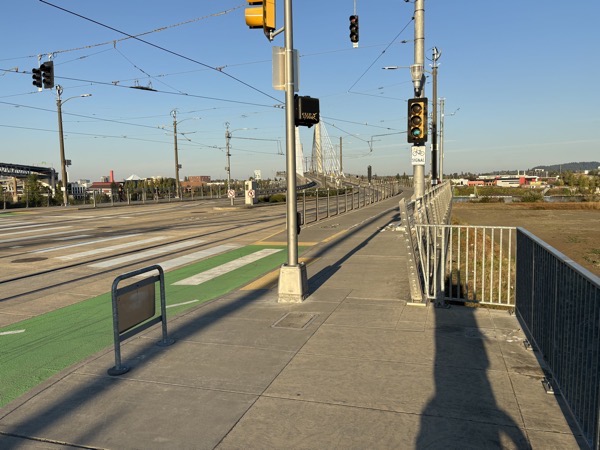
a view of the Tillikum Crossing in Portland

In the summer of 2020, like a ton of people, I ordered en e-bike. In 2023, after installing a handlebar riser and eliminating the wrist pain I was experiencing riding, I got serious about biking as a hobby, biking over 250 miles, and this year I’ve biked a little over 320 miles so far (and I’m sure there will be some other short trips).

Call me yet another blogger in a long line of bloggers who started using e-bikes and then couldn’t shut up about how great they are, but I love mine. I previously owned a non-electric bike, and they’re nice enough, but hills (and let’s face it, even roads that slope ever so slightly upwards) are kind of daunting. With an e-bike, I don’t really think about hills at all; I just think about distance and whether there is a route that seems relatively bike-friendly, with bike lanes, less busy streets, and easy ways to cross busy thoroughfares. The end result: I bike more. A lot more. And maybe I burn fewer calories per mile on my e-bike than I would on a traditional bike, but I have put so many more miles on my e-bike that it doesn’t matter; I’m easily burning more calories and replacing more car trips with the e-bike.

A bike ride feels fundamentally different than a car ride. I may be going slower overall, but it’ a lot less stop and go. In the car I will have to stop at a red light with a dozen cars ahead of me, only to inch forward, but on a bike lane I skip past all the cars at red lights every time, including the cars that so overconfidently were passing me just seconds before. For short trips the bike is hands down the fastest, and for moderate trips it’s still the most enjoyable.

When I’m moving, I’m moving slower, but I get to take in the environment around me. On a ride to my local library, I notice all the homes that make up my neighborhood. My neighborhood is old enough that it the homes don’t all look homogenous. They are different sizes, shapes, and colors, and are in varying states of repair. One of my neighbors has a 10 foot skeleton they keep in their yard year round. People leave interesting fliers on electric poles. In my car I’d just be racing past each of these things, but on my bike I get to appreciate my neighborhood and feel like a part of it.

When I’m cooking and realize I’m missing a key ingredient, I can hop on my bike and make my way to the corner market nearest me in just three minutes. If I’ve got a hankering for a bagel, there’s a great bagel place just a block further.

Sometimes at the end of a work day I’ll bike over to Mount Tabor. Parking there is a pain but I can just bike to the very top and not think about parking. My bike’s motor is great at getting me up that hill without even being on the highest assist level. I sometimes bring a hammock and relax up there for a bit. It’s incredible that in less than a half a mile I can go from being in a dense-ish residential neighborhood to feeling like I’m out in nature (albeit nature with a view of the city).

On weekends I like to hop on the Springwater Corridor Trail, riding it toward the city center. Along the way I pass through quieter neighborhoods, near an amusement park not far from the yacht club, and for a few miles I’m parallel to some semi-abandoned railroad tracks and shuttered buildings. It’s so serene. The trail is lined with wild blackberry bushes and during the summer you can stop and grab your fill of them. After the trail I’ll stop at Wu-rons, a hole in the wall ramen shop that has delicious tonkotsu ramen.

A few weekends ago I took a little afternoon trip to Farina Bakery on Hawthorne. What would have been a tedious car trip was instead a quaint and lovely bike ride; I took Clinton Street much of the way. Clinton street was made into a bike boulevard awhile back, making several intersections not crossable by car so that the street is quieter, and there are several art installations celebrating biking. I pass through the Ladd’s Addition neighborhood and it is a stunner of a neighborhood in the fall (and really any season), lined with trees and featuring a massive roundabout in the center of the neighborhood.

I love the concept of micro-mobility but this isn’t about the greatness of investing in micromobility (though I can’t make these bike trips without the benefit of those infrastructure investments). Portland has been my home for five years now, and I arrived here on the eve of a pandemic that left me confined to my home before I really got to know my new city. Through all these years I’ve driven around different parts of town enough to gain familiarity with it. But on my bike I feel this much more intense personal connection to the neighborhoods. It’s not just an arbitrary place I’m domiciled; biking around Portland has made it truly feel like home to me.


I drafted this post the night before the election, feeling decently confident the election wasn’t going to end up the way it did.

But reading through this draft again felt strangely like a good response to the news, and it’s part of how I plan to cope with this.

It’s really easy to get overwhelmed by national and world news like this, and a good remedy for that is finding something more to appreciate in your own backyard.

This isn’t an endorsement of ignoring or hiding from the world, but to instead embrace the world immediately around you. Your sphere of influence on the entire country or world might be small, but your sphere of influence on your neighborhood is considerably larger, and I hope that the community around you can become a better source for comfort. And very importantly, if you have the bandwidth, I encourage you to be a greater presence in your communities so that others might be able to reach to you for comfort and safety, because they may need it.

💙💜💚💛❤️💙💜💚❤️💛💙💜💚❤️