Sep 10 2011

What’s Apple’s next big major product?

Perhaps the biggest concern Apple aficionados have about Steve Jobs’s departure from Apple isn’t that Apple will suddenly fall apart, but that there won’t be any breakthrough new products like Mac, iPod, iPhone, or iPad.  It’s a fear of mine as well, but I think the next area Apple’s going to revolutionize is the living room through Apple TV.

Apple’s had the Apple TV and despite anemic sales they’ve kept it around as a “hobby” of sorts in terms of their sales performance expectations. Apple knows there’s something there, but they haven’t quite put enough into it to really hit it hard.  However, if you look at the markets Apple has gone into in the past, this one is a really perfect logical next step for them.

Let’s look at the four major product lines Apple has made that revolutionized computers.  You could even say there are five. They are the personal computer (Apple //), the reinvention of the personal computer (the Mac), the MP3 player with iPod, cell phones with iPhone, and then the tablet world and even perhaps another reinvention of personal computers with iPad.  Let’s look at each of these product categories and see if we can find a pattern:

Before personal computers, you bought computers in kits and had to assemble them yourself at the component level. Some had no monitors at all and instead had some blinking lights. You often had to make the case for the computer yourself.  It was a major geek tool.  Apple came along and changed the computer into a product you could use right out of the box, complete with monitor and keyboard. Very little assembly was needed.

As these computers grew in popularity, they still remained something that not every household had. After all, there was quite a bit of a learning curve associated with using a computer, and interacting with a computer by using keyboard commands isn’t everybody’s cup of tea. Apple sought to solve this first with the Lisa, but then tried again with Macintosh, an all-in-one computer that featured a graphical user interface that you interacted with using a mouse. This was a ground up rethinking of how the computer worked, even though it a lot of the components appeared similar.

Then, for a really long time, no game changing products came from Apple. Sure, there were clever things like Newton coming out (and let’s not forget about Pippin!), but half-baked implementations left them doomed. Steve Jobs was gone, and though that didn’t necessarily mean Apple had to be doomed, the leadership that replaced him were incapable of making great products.

But after Jobs returned, we soon after saw a new market arrive.  MP3 players were around at the time, but they all either had pathetic capacities (like 32 megs, enough to hold maybe 10 songs if you’re lucky) or if they were hard drive based players, they were bulky, because they had a 2.5″ hard drive in them. And using them was a pain. They had USB connections to the computer, and it took a really long time to copy tunes to them. And the UI wasn’t that friendly. It was analogous to a CD player’s UI.  Then, iPod came along. iPod solved all of these issues. It had a huge hard drive (5 gigs was insane at the time), a great 10 hour battery life, and it was the size of a deck of cards. And it had a great UI, and it was easy to browse through a large library of music. Copying music to it was easy, too. You just plugged in the FireWire cable and you copied a song or two per second.

Cell phone use was growing in the mid-2000s, but as they were trying to get more sophisticated, they sucked at it.  Cell phone data plans charged by the kilobyte and were extremely expensive.  Using the internet on one of these things was an exercise in futility. You often had to view things with a crippled browser with no JavaScript or any rendering resembling anything like the web page. The phone was riddled with buttons everywhere, and navigating through the UI of the phone itself was painful. Then, after long awaited rumors and endless mockups by users, Apple does come out with a phone. It’s simple and elegant, having only two exterior buttons (plus volume control and a silencer). The screen is large and all touch based.  It’s an order of magnitude easier to use than any other smartphone that’s ever existed. And smartphones have never looked the same since then.

Fast forward a couple of years, and you’ll see that there is a growing murmur that Apple is hard at work on a tablet computer. People seem to love the concept of tablets, but none of the ones on the market are particularly good. They are all running essentially the same desktop Windows OS which isn’t well optimized for a tablet, or it’s using a proprietary tablet OS that doesn’t have many apps available for it (see: Archos).  Apple releases iPad, an elegant tablet that runs the well established iOS, is very thin and relatively light, and thanks to Apple’s now sizable clout in the supply chain, has a price $300 lower than what pundits expected. Competitors are struggling to make a competing device that matches iPad’s price, let alone beats it.  iPad has a level of simplicity that desktop computers have never managed to achieve because iPad throws most of the conventional desktop UI patterns and metaphors out the window.

Picking up on a theme here? Apple looks at existing devices or classes of devices whose user experience is poor, and it simplifies them. A lot of anti-Apple pundits brush this effort off, as if redesigning phone UIs is nothing more than putting a paint job on something. If making the product Apple-caliber were as simple as these people say it is, then every other company would be doing it too.

But picking up on this theme and following Apple’s very public statements every quarter that Apple TV is a project that they see something in, I think Apple’s moving into the living room next with a reinvented TV experience. I might be going out on a limb here, but I think it might actually be a full blown TV.

TVs are a race to the bottom right now. They’re very much a commodity, and they’re made by various Japanese companies that pile on meaningless features and numbers onto the TV’s box hoping that it will make consumers feel like they’re getting great value. The TV’s remote control manages to have dozens of buttons, despite the fact that people only use a few of them anyway and don’t know what most of them mean (even technical minded folk like me are included in this).  The TV has an array of ports on the back that most don’t understand, and each TV is a little different to use from other TVs. When you go to someone’s house and they have their own TV/home theater setup and you want to watch something, you have to ask your host exactly what the hell you need to do to get the TV working. Though setting a TV up is usually straightforward, it sure isn’t friendly, and companies like Best Buy have been eagerly capitalizing on it by charging hundreds to send a minimum wage worker to your house to set it up. Profit margins on TVs are laughably low, and even though the TVs have a seemingly huge amount of functionality on them (as evidenced by their myriad remote control buttons) we usually derive all of our functionality from the devices we connect to them. These are the set top boxes. Nobody likes them, yet everybody has several. And inevitably, each set top box has its own overly complicated remote control.

It’s a fucking nightmare.

I think Apple’s next product is going to be a TV that eliminates all of this complexity in a major way. The new Apple TV will not be riddled with a ton of ports on the back. In fact, it might not have any at all. Maybe a way to connect speakers, and maybe a USB port or Thunderbolt port just in case.  The remote control will be simple. It might even be a simplified handheld iOS device with the Remote app.  Or maybe it won’t come with one at all, because you’ll be expected to use your own iOS device to control the TV. There will be no DVD player. No cable set-top box. No TiVo.

Instead, it will get all of its content from the internet. With iCloud you’ll be able to access and listen to all of your music and TV shows and movies. It will be powered by iOS and there will be an SDK so that developers  and content providers will be able to make their own apps that are sort of like channels. You will be able to subscribe to these on a per-network basis, or maybe even a per-show basis, and pay smaller subscription fees for just what you use. Netflix will be there, MLB will be there, NBA will be there, perhaps some other sports channels will be on there.

iOS has grown into an incredible gaming platform, and this will happen around Apple TV as well. I think selling Bluetooth game controllers a la Wii would be a bit too conventional. Perhaps iPhones will be the controllers for those games. Don’t get me wrong, I’d love a controller with some buttons so I could play some platform games with a lot of fun, but it’s not very Apple-like.  These probably won’t be games for the hardcore gamer, but they’re going to be really great casual games for the families with children and people like me who don’t have much patience to spend hours gaming.

People will lose their shit at the thought that Apple has the audacity to make a TV that doesn’t have the expandability of being able to add extra set-top boxes. There may even be some fear of planned obsolescence given that iOS sees a regular release cycle and people expect their TVs to last a decade or so. People will complain that Apple is killing the DVD too early. People will complain that Apple is doing this to hold back customers from having the control to add things to their TV. Really, this is just a simplification of something that is way too complicated. We’re ready for DVDs to die, and we’re ready to see the TV become smart.

Alternatively, I could see a universe in which Apple doesn’t quite go so far as to sell the TV itself (it is admittedly a race to the bottom) but I can see them revamping the Apple TV set top box to do all of these things.  That would be less bold for sure (and I’d be stuck having that monstrous TV remote around just to turn the TV on and off) but it would be a crowd pleaser. Still, it isn’t characteristic of Apple to take that road.

I am confident that things are about to happen to Apple TV, and the potential market for it is huge. I’m pretty excited to see what Apple comes up with.

Sep 3 2011

In defense of the Ribbon-ization of Windows

The initial reaction to Microsoft’s unveiling of the Ribbon in Windows 8’s Explorer.exe has mostly been sour.  Of course, most of these people are using Macs and they see this as an over-complication of the UI.  Those defending Windows accuse Apple of “dumbing down” Finder to “make it look pretty” (seriously, this is a direct quote from the top comment on TechCrunch).

Though Windows isn’t my OS of choice (for a lot of reasons), I was pretty fond of Microsoft’s design choices when they switched MS Office to use the Ribbon, on the surface an uncharacteristically bold move for a company that has always been very conservative with moving things forward.  Of course, the boldness here is really pretty superficial because it mostly amounts to an (admittedly good) rearrangement of all the stuff that was already there.

Microsoft knows that its users will backlash whenever they make a UI change whether it’s good or bad, because most users just hate software companies mucking around with their internets and such.  And given that Microsoft already deals with corporations whose upgrade cycles are painfully slow, they don’t want their product having a bad reputation.  Even if it’s completely unfounded, the perception that the changes are bad has the potential to influence big wigs at corporations who will tell IT not to move forward with the upgrade. So Microsoft is pretty timid when they present this stuff, and they started off their blog post with a ton of explanation of the research they’ve done.  The conclusion: some small percentage of commands make up 90% of what people do, and these commands are buried in awkward places (I’m paraphrasing, also I only skimmed it, but believe me, that’s what they said).

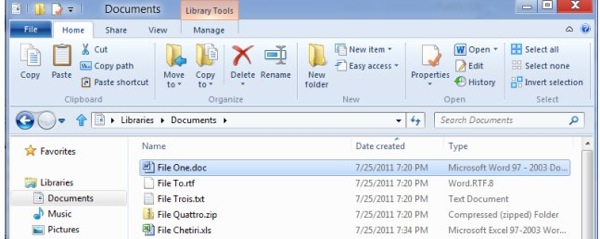
So, they put those 90% in one place:

Windows 8 s New Explorer This One Goes To 11 | TechCrunch

I still really don’t get the whole thing with the name “Home” for the main tab, but whatever. All the common things you might want to do with a file are right here.  And the things you want to do more frequently have larger icons than the things you don’t do as often.  I haven’t played with a beta or anything, but this one screenshot looks really nice.  It’s long time that the Ribbon made its way to other Windows applications.  Microsoft has way too many UI schemes in Windows and the more they can cut down on this, the better.

Though I think these are real improvements, the way Microsoft solved these issues is still very Microsoft-ian.  I can best characterize Microsoft’s approach to these issues versus Apple’s with the following metaphor: if you found that you had to cross a swamp, Microsoft’s solution would be to give you a pair of boots to cross it with.  Helpful.  Apple’s approach, however, would be to drain the swamp.

As you can see above, Microsoft assumes that you want to manipulate your files in essentially the same way that you would have with a command line; that is, performing a command on a file (or files).  When the GUI came along, Microsoft decided that the best way to deal with this would be to let you use commands to manipulate the files.  On the Mac, the main approach to manipulating files is more physical.  Instead of issuing commands, you do a lot more dragging and dropping.  And in Mac OS, the GUI is designed very clearly for this to be the way for you to manipulate your files.  You have spring loaded folders, the toolbar doesn’t have many commands on it for the file, and Apple disables the “cut” action in Finder to keep you from cutting and pasting files.  The ability to “reveal” a file in the Finder is very important so you can get to the file to do what you want to it. it’s a lot more common in Mac OS than in Windows.

Is one approach better than the other? Hard to say. I admit, I manipulate my files using Alfred quite a bit.  However, I salute Microsoft for coming up with an original UI pattern and sticking with it enough to start putting it in other core Windows apps (I know the Ribbon made its way into several core Windows apps in Windows 7, which excited me as well). Of course, Microsoft’s choices aren’t all great ones like adding the Ribbon to things.  There is this nagging notion of Microsoft basically splitting Windows 8 into having two UIs because Microsoft wants you to have the same OS for your tablet and desktop computer, ignoring the fact that you basically are just shoehorning two very different user experiences into one. That one, I just don’t get.

Peace out. Namaste.


Sep 3 2011

This is just embarrassing, Evernote!

Evernote posted a remarkably cool product in their blog (http://blog.evernote.com/2011/09/02/htc-tablets-and-evernote/) by HTC. Understanding that this is a major thing to me to say, it’s the first time I have seen an awesome feature in a non-iPad tablet that made me want to replace my iPad with it.

This new notebook app is a full blown Evernote client, and it allows for a super natural method of note entry. You can type in text as needed, you can scribble as needed, and you can annotate the text with scribbles when needed. You can record audio. The audio syncs with the keystrokes you type so you can very easily get audio context when you are taking notes for something. I admit, I’m not the heavy note taker that I used to be, but I would have absolutely loved to have had this when I was in school. This is a killer feature.

And Evernote should be thoroughly embarrassed that a third party had to come out with this before they did. It’s not like Evernote doesn’t know people want these features. Evernote has been anemic at coming out with all of its most requested features. We’ve been demanding rich text editing for, I don’t know, three years now? It just came out last week. I wouldn’t complain about this so much if Evernote was focusing on making their app super high performance, but it doesn’t really perform that well in that respect. They brought their Windows client up to par after realizing they needed to do a rewrite in native code instead of managed code (surely no small feat and I salute them for it) but on the Mac client it takes seconds for a new note to appear when I click the new note button. I can forgive up to a half a second or so, but 3-4 seconds is just brutal for a task like that. For comparison, Mail.app provides me with a system largely like Evernote (a large searchable library of snippets of information) and I have well north of 100,000 messages in Mail. I’ve yet to see Mail lag, even on hardware that is relatively slow (and I’m running Evernote on good hardware). If Evernote blew me away with its core functionality I wouldn’t be complaining as much because they could point to their app and say “it takes effort to get the fundamentals right, so STFU”, but in reality it is pretty mediocre execution. It’s forgivable for a young company, but Evernote is past that point.

I understand that Evernote can’t grant every user’s feature requests and they realize that too, and they tried mitigating this with Evernote Trunk, a curated collection of apps that integrate with Evernote. I usually don’t see very good integration (mostly it’s a “click a button to manually send a PDF of this to Evernote!” type of integration rather than really being baked into Evernote) and although I assume this was supposed to leave Evernote to focus on core functionality rather than loading its clients up with extra features most users don’t need, but I didn’t really see any progress being made. Usually even though I store all things I want to look up later in Evernote, the reality is that I can usually just Google something and get my answer a lot faster (for instance, yesterday I needed to find a note I made for setting the hidden flag to false for ~/Library on the Mac. I spent 2 minutes searching for terms I knew were in the note, and Evernote never found them because its search algorithm ignored it because the word didn’t start with what I was searching for. I never found it in Evernote. I googled it and found the answer in under eight seconds). On the mobile clients, performance is worse yet.

Evernote just closed a round of funding even though they have all of their last round in the bank still and despite the fact that they are still profitable. This puts them in a great position for the future, and it enables them to be around for 100 years, which is their goal. That’s an important goal for a company that wants to be relied upon by people as their second brain. I listen to what the Evernote team has to say about feedback and it is quite clear that they are aware of what people want. They are also moving in the direction that people want them to be moving in. But they’re really slow at doing it, and it occurred to me that HTC being able to make this notebook app that is a full blown Evernote client with features Evernote clients probably won’t have for years if ever in a fraction of the time it took Evernote’s team to add rich text editing to its iOS client shows that this really needs to be a wake up call for the Evernote team. But they’re oblivious to it. Instead, they’re thrilled to see a developer making these great features and truth be told, they should be. Those suckers at HTC just made Evernote an app for free, and now Evernote doesn’t have to listen to its HTC tablet users beg for months for Evernote to make a client for them.

It’s really important to keep in mind here that you don’t hear me uttering a single complaint about any of the many other note taking and information management options out there. Know why? It’s because I don’t use them at all. They’re all missing some really important feature to me that Evernote already has. Evernote may not do any of what it does well, but it does do the essential things I need it to do well enough that I don’t look elsewhere. Evernote manages to always do just enough to keep me from getting rid of it.

I guess that’s a decent strategy.


Aug 28 2011

So Steve Jobs Calls Me Up Again

So I’m sitting here this morning doing some meditation and my phone starts ringing.  I notice the number is a Cupertino number.  Excitedly, I pick up.  It’s my favorite former CEO!

“Steve, my man.  I was wondering when you were gonna call.”

“Hi, Aaron.  I wanted to let you know that we can talk a bit longer now, because it’s free mobile to mobile for us.  I finally got pissed at AT&T and I’m all Verizon now.  My goodness, what a relief!”

“Whoa, whoa, whoa.  Steve, you didn’t switch already?”

“Nope, I really felt like I wanted to repay AT&T for making it possible for iPhone to be itself.  So I stuck with them.  But I was in a call a couple days ago and the motherfucker wouldn’t stop dropping calls and I decided I’ve had it.  And to top it all off, AT&T made me pay the early termination fee.  I fucking hate cell phone companies.  But I’ve never had better call quality.”

Steve sounds like he’s in a chipper mood, though his voice does have this exhausted quality to it. I don’t think that’s going away anymore, though.  It always shocks me a little to hear such weakness in his voice and it left me speechless for a bit, but finally I broke the ice, “So the stocks took a bit of a hit on the initial news, eh?”

“Man, Aaron, I was prepared for that to be a real shitstorm. These Wall Street people are the biggest fucking morons on the planet. If they stubbed their toe they’d extrapolate that and then amputate.  It looks like we’re handling it okay, though.  I think they’re finally starting to get the message that despite their predictions, Apple is going to dominate.”

“No doubt, Steve.  You guys are the fucking kingmakers over there.  So you decided to go with Tim as CEO, huh?”

“I did.  Phil is good with the public and everything, but let’s face it. Tim is an operations master.  He may not be a product visionary, but without him, iPods would have never cost less than $350.  And the really brilliant thing about us now is that we no longer make the higher priced version of stuff.  We can sell an iPad for $500 profitably.  None of the other guys can profitably make a tablet that even comes close in price. And even if they do, it’s a fucking piece of shit.  We’re not the old Apple anymore, stuck with higher prices for a product, even if the product is good.  Now ours is the best in class, and it’s the most affordable.  That’s all Tim, and he’s earned this CEO spot.”

“On that note, how are you doing? You’re not going to be dead in a week, are you?  God, I hope not.”

“No, I didn’t take a turn for the worse or anything. But last week I was walking back to my office to answer an email, and when I got there, I just felt so exhausted.  It began to hit me that the day to day stuff is taking a lot out of me.  So, I decided it’s time to step down.”

“So, this is Apple post-Steve again?”

“Well, you need to keep in mind that I’ve been on medical leave for awhile, so Apple’s been moving along without me.  But this is going to be a transition.  The real beauty of this is that I can still be involved. It’s not like I’m going to walk into Apple’s campus tomorrow and be escorted out by security at Tim’s request.  They will do whatever I tell them to do.  It’s just that now I don’t have to worry about all the random bullshit that you have to deal with as CEO.  Any time I spend at Apple can just be focused on the products.  And that’s really the reason people worry about me leaving. They worry about the products.”

Yeah, it wasn’t like they were worried about Steve’s health.  “I mean, it’s obvious that Apple has laid a foundation over the past few years that they could just coast on for the next decade.  But Apple has only come out with things like iPhones and the iPad and iPod under you.  Can Apple make new game changers without you?”

“Oh, Aaron, people give me far too much credit for what I do for the products at Apple.  iPhone was made by a team of brilliant people.  Yeah, I made some decisions about it, but the team knows their shit.  And I honestly don’t know what the next blockbuster product is going to be.  Is iPad the device that will replace the personal computer? I don’t know.  Will something replace the iPad? I really don’t know.  People act like I had this vision for all of these major devices since the eighties.  But it’s mostly luck.  It’s seeing a 1.8 inch hard drive and thinking ‘wow, that could hold a ton of MP3s in your pocket’ or seeing multitouch and realizing that it could make a touch screen device far more usable.  There’s still a great team of engineers there that I think will have great ideas for products they can make with some of the new technologies that come along.”

Ah, he’s just starting to riff a bit. You really hear some gems this way.

“I know it feels like we’ve come along way.  You look around and you see devices in your pocket that are far more powerful than what previously would have filled an entire room.  But what we’ve started here, these new norms of always being connected, always having a super easy-to-use device with you, this is a completely new era of technology, and it’s just in its infancy.”

“So Steve,” I ask, “tell me, when you were showing iPhone to the world in January 2007, was your intent really to never have native third party apps, or were you just stalling with your ‘we don’t need no stinkin native apps, we have web apps’ rhetoric at the time, knowing full well that you were working on a proper SDK?”

“Aaron, I think you know as well as anyone that not every decision I make is a hit.  Honestly, I’m not totally sure what my thinking was at the time.  You have to remember the state of mobile phones at the time. It wasn’t like today where the mobile platform dictates the user experience.  Back then, it was all the carrier.  We were really new to phones at the time, you know?  I think it’s a mix of both, though.  I knew that if we tried taking on a native SDK from day one, that was going to be an utter failure. We had to get the fundamentals right before we went onto new things.  And we knew better than to just promise people we’d add it later; it would have killed off sales.  And iPhone’s Safari browser was just incredible.  So we decided to address native apps by offering Safari apps.  But, of course, that didn’t really work out.  People protested that. Hell, you wrote a blog post about it.  Ars stopped recommending the iPhone to people because there were no native third party apps and it didn’t seem like we were interested in making one. So we talked about it and we decided that a native SDK was the way to go.  That was obviously a great decision.”

“Indeed it was.  Indeed it was.  Now, I’m going to spare you from talking about Apple for awhile now.  It’s been great hearing you talk about Apple and technology.  I know you’ve probably gotten a flood of emails from fans saying how much they appreciate what you’ve done, and you of course know that I am a huge fan of what you’ve done for technology in your career.  So, thank you for that.  Now, what are you going to be doing now that you’re semi-retired?”

“Thanks, Aaron.  Coming from you, that really means a lot.  I am going to finally relax a bit, and spend more time with my family.  I’m excited to enjoy the new house, too.  You know, you can visit any time.  Laurene really wants to do dinner if you’re up for that.  I’m hoping we can think up some ways to fuck with Gizmodo editors.”

Man, I am so in.  “Can Johnny be my +1? I want to get him drunk and he can design up a really crazy prototype that we can leak to the Giz editors.”

“Wow, you need to be on Apple’s PR team. That’s just brilliant.  I think I’m going to go take a nap on the hammock outside, but I’ll talk to you soon, okay?”


Aug 12 2011

Bert and Ernie tying the knot

I was excited to hear that a petition was going around to Sesame Street’s creators suggesting that Bert and Ernie finally get married. Given the strides we have been making for gay rights this year, I feel like it’s really the right time for this to happen, and Bert and Ernie are great candidates for a gay couple.

Sadly, Sesame Street released a statement saying that Bert and Ernie are puppets and have no sexual orientation, and that they are just good friends who live together. More than a few people jumped on the “well, duh, they’re puppets, not people” bandwagon. Apparently puppets live in houses, can talk, have conflicts with each other that they solve, and are otherwise quite anthropomorphic. But two male puppets getting married? Duh, puppets can’t get married. The argument is just silly to me. Why is it that the puppets can be anthropomorphic to the extent that they can teach children real lessons, but it suddenly becomes silly to do the same to teach children about gay people?

I am disappointed that Sesame Street would shy away from addressing a real issue society faces given their history of tackling difficult and controversial subjects. Though no muppets that I know of have gotten married on the show, humans on the show have. There was absolutely no backfire of people complaining that children that young may not know what a wedding is.

And Sesame Street completely failed to see the message of what we were asking for when we petitioned for Bert and Ernie to tie the knot. This wasn’t a bunch of viewers trying to have an influence on a specific thing the two characters did. This was a request for Sesame Street to have an episode to teach children about the notion of gay people. Framing it in a wedding is a great way to accomplish that. You don’t have to explain concepts of sexual attraction. Sesame street simply would demonstrate here that two characters love each other. It has nothing to do with the fact that they’re puppets. Sesame Street didn’t even have to have it be Bert and Ernie getting married. They just seemed like the logical choice, since they are already unofficially regarded as a gay icon of sorts.

Even the argument that the children are too young to be exposed to thoughts of marriage in general, let alone same sex marriage, is hogwash. Shielding children from knowing about other sexual orientations or the notion of a sexual orientation in general only leads to a heteronormative world view. When the children become teenagers and start to discover that some of their friends (r even they) are gay, it’s opening up a world of confusion that only exists because of this notion that they needed to be “protected” when they were younger.

And let’s not forget here that we are already teaching children to appreciate and be aware of familial diversity. We work hard to teach children that families are all different. Some families have two parents, some have just one, some have separated parents, some children are adopted. We push hard to cover all the bases, only to suddenly stop short when it comes time to say that some families might have two dads or two moms.

I hope Sesame Street takes the opportunity to step up on this issue. They will surely offend some people doing this, but only the people delusional enough to think they can be well-adjusted people without being aware of and accepting of gay people. And it doesn’t have to be Bert and Ernie. They can be the human characters.

Peace out.


Aug 11 2011

wild pirates slot machine

Despite being on the approach of an effective duopoly with the AT&T-Mobile merger, cell carriers are living in fear right now of losing control over the user experience.  The focus is shifting from things the provider has controlled to a focus on the phones and the software they are running and the user experience that software provides.  Seeing this loss of vertical control, the carriers are in a panic, trying to figure out how to increase revenues for cell data. You really can’t believe that data caps are about a lack of capacity, or even the carriers’ unwillingness to build out more towers in smaller areas (which is expensive and takes awhile to do).  We’re quickly transitioning from a model in which you go to your carrier for everything, from picking out the phone to the accessories for it to the ringtones to the apps, to a model where you buy your phone from the Apple Store and might never actually set foot in your carrier’s retail store.

That loss of control seems scary for carriers, but the reality is that it’s liberating them.  You hear about companies laying of masses of workers, talking about how they want to focus more on their core businesses (read: the ones that make them more profit).  Running thousands of retail stores, many of which are owned by a third party, isn’t cheap.  Sure, they mitigate this with impressive markup on prices in store and by training the minimum wage employees to sell a clear plastic sticker ($20) to stick on the phone screen that’s made of much stronger Gorilla glass, but having the stores around is dead weight.  Offering a bunch of other ancillary services is costly, and it ultimately deflects from what we pay carriers for, which is providing a kick-ass network.

“Surely, Aaron,” you say skeptically, “this model of losing so much vertical control isn’t going to work.  I mean, this would be like asking Apple to just focus on software and license it out to third party hardware makers!”

Glad you asked, but no, that’s not really the same, because Apple is actually good at making both its hardware and software.  Carriers are shoddy at everything they do that isn’t being a network, except maybe charging too much for letting people use the network.  Furthermore, I can present you with a really fucking good example of a model in which the network providers are all dumb pipes: the internet.  This model works incredibly well, and it keeps the internet prices relatively low.  The argument could be made that they should improve in the US, but overall internet prices are great, and your ISP isn’t trying to make its bread and butter selling you a computer to connect to the internet with.  PeoplePC used to, but couldn’t make money doing it.  Yes, ISPs are often trying to bundle their service with other non-internet crap you don’t need, but for the most part they aren’t selling you the equipment you use to use these services (like the phone/TV/computer).

This model is for sure the best for consumers, and it would give the carriers the ability to focus their efforts completely on their product.  As feature phones with carrier-made app and ringtone stores are becoming increasingly passé as users get smartphones that come with their own app stores, there aren’t really going to be any new services carriers can offer.  In that respect, data is the final frontier of these services.


Aug 9 2011

online casino slots wolf run

The announcement of it caught me by surprise today, but Facebook released a new app called Messenger, a standalone iOS/Android app that handles just your Facebook messages. It adds a couple features to make it well suited to phone-to-phone communication and group planning, but it’s mostly a pretty simple app.

I used it a bit today, and it’s really elegant. It lets you really easily send text and picture messages to friends or groups of friends, and it does it really quickly. It loads almost instantly, so there is almost no loss compared to the native Messages app.

This was really a genius move on Facebook’s part, but most of the really cool things about its future (which I’ll go into in a moment) really just reflect Facebook’s best assets. Many people are convinced that this is a nail in SMS’s coffin. It very well could be, but it’d have a long way to go.

Facebook isn’t the first company to come out with a smartphone text messaging platform. Blackberry, Groupme, Volly, Apple and many others have released their own offerings. Many even offer bridges to SMS for those friends who don’t have it, but because natively sending messages in all of these platforms requires some action on the user’s part (even if trivial, like downloading an app and making an account) it’s already probably going to be dead in the water in terms of gaining friction. There already exists a text messaging platform with the ultimate ubiquity: SMS. Indeed, it’s a ripoff. To say that profit margins for SMS are above 90% is a very conservative estimate. Sending a text message costs virtually nothing and carriers are making bank from SMS. However, people love and stick with SMS because you can send an SMS to just about any phone number and you can count on the recipient being able to receive it and being able to natively text you back. Whenever a replacement service comes along, there aren’t that many users you can say that for initially, and so the service falls back to using an SMS from what is undoubtedly a strange number to the recipient, usually with some wrapper information saying “hey, this is a text from <3rd party service>“. Your friend could install the free app, but probably won’t. After all, why install this brand new app and totally separate messaging system just to talk to this one person? And the friend never installs it and the original sender stops using the service and just falls back to using SMS.

This is where Facebook’s assets come in. Chances are that the friend you’re texting is using Facebook. 94% of Americans under 50 have an account (i heard it from a commenter on TechCrunch, so it must be true). That little gem of a statistic right there is why Skype was all over having their technology used for Facebook’s video chat (which doesn’t require a standalone app). It’s why thousands (actually, millions) of web sites are starting to use Facebook to let people log in. A lot of web sites switched to using Facebook accounts as an identifier for posting comments. Facebook (and to an extent Twitter) has become a de facto standard for your online identity. I think this is far more important to Facebook than anything. Sure, a deep level of information about users can be valuable, and it makes Facebook appealing to advertise on (that gives Facebook some financial stability) but Facebook profiles are a fantastic way to identify people. Email addresses are poor identifiers. Phone numbers are poor. Facebook addresses that easily by being a pseudo address book, and in the case of sending messages, the name of the person is the unique identifier.

It’s really far too early to tell but I think this ubiquity is going to give Facebook Messenger a real shot at replacing SMS for a lot of people. Facebook isn’t on every cell phone on the planet like SMS, but I’m willing to bet that well over 75% of Facebook account holding smartphone owners have the Facebook app installed, and they would more than likely also install the Facebook Messenger app.

Facebook has a lot of viral things going for it here, too. The ability to send a message from the desktop to a mobile device is surely useful (one of the things I miss most about primarily using Google Voice) and especially useful for the non-cellphone owners.

If Facebook succeeds in reaching a critical mass of users it’s going to put a sizable cut in SMS usage in the medium term. People will hold onto their SMS plans for that shrinking number of friends who only can be reached by SMS. Eventually that pool of people will just include feature phone holdouts who won’t buy an iPhone and Facebook holdouts who are convinced that Facebook is harvesting data about who Marco is having sex with to sell to some corporation who is willing to pay a good price for information like that.

Then again, maybe Facebook won’t reach that critical mass, and it will just be one more competing standard for methods of text communication. I’ve sure seen a few of those in my time. Now, if you’ll excuse me, I need to go read this iMessage that just came in.


Aug 3 2011

Life without Flash

I decided a couple months ago to just remove Flash from my computer outright. I’m not really outwardly in a pissing match against Adobe or their technology offerings (though I feel like they no longer represent the pinnacle of great creative software like they did before they bought Macromedia, and incidentally I think Macromedia’s products are worse since the acquisition too), but the primary reason I decided to remove it was because I was concerned about battery performance on my laptop (and performance in general).

Make no mistake. Flash is a remarkable vector graphics program, and its bandwidth efficiency made it a great choice for adding interactive vectorized content in an age where IE6 was considered state of the art. But the use cases of Flash have shifted from what it was best at to being a platform for distributing video (not animations, but full blown video), and that frankly is something Flash sucks at. But with its impressive install rate on people’s machines, it made itself the de facto standard for online video. Better alternatives exist today, and they are now common enough and they work better enough that the benefits of using Flash are disappearing.

So I got rid of it. I was a bit concerned that the Internet would start feeling crippled, but with over half of online video now available in an HTML5 format, that eased my concerns. A couple of months into it, there is almost nothing that I miss about having Flash on my computers. If a video or web site is Flash only, I simply don’t use it. I’ve yet to miss anything of any significant importance.

The biggest annoyance I experience with the lack of flash is not the existence of those “missing plug-in” boxes, but the fact that I can’t scroll past them with my mouse. They absorb all of my scroll input. I could write a simple Safari extension to remove those Flash embed links but i’m honestly too lazy. Maybe I’ll get around to it.

I’m not going to downplay the fact that some stuff is missing from the web; I encounter it every day. But it’s usually stupid cutesy stuff, like FarmVille. There don’t exist many legit tools that are reliant on Flash, and even if there were, i’d rather cast my vote for the developer to make an HTML app instead by visiting that site without Flash.

I’m now at the point where going Flash-less is something I would recommend to friends. Again, yes, you will miss stuff. But I’m pretty certain you won’t miss anything that great. Mre importantly, removing Flash from your computer helps make an increasingly compelling case for web developers to accommodate these users who don’t have Flash.

Adobe may have gotten all self-righteous when it told Apple that they weren’t being “open” in their decision to not support Flash. Make no mistake. Flash is absolutely not open. It’s completely proprietary, and you are at Adobe’s mercy when it comes to them deciding whether they will support the device you choose. Web standards, on the other hand, are completely open, and if someone came out with a new device tomorrow, they could include a web browser with it and it could support pretty much all web content from day one. Flash is a technology that is nearing the end of its life cycle.

And Adobe knows that Flash is on the way out as well. They just released a new app called Edge which is designed to let people create rich web content that doesn’t require a third party plugin because it turns it all into native HTML.


Aug 2 2011

How I will know when Republicans are serious about the deficit

1. The defense budget will start coming under serious scrutiny. Our military is the absolute archetype of inefficient government bureaucracy and lack of accountability to boot. We are #1 in military spending per capita by a long shot.

2. There will start to be a serious conversation about drug legalization. For one thing, making drugs illegal is excess government regulation which Reupblicans claim to be against. Other countries, like Portugal, have legalized all drugs, and it has been a blinding success. Assuming we have 2 million people in prison (it’s probably closer to 3 million than 2) and assuming it costs $40k per year per prisoner (it’s actually more expensive) we spend $80 billion to keep people behind bars. About half of those inmates are in for drug crimes. Decriminalizing all drugs and instead focusing on rehabilitating those who are addicted has the potential to save a huge amount of money, opens up a modest revenue stream for the government through taxation (this will probably just fund programs to help those who are addicted) and it frees up a lot of prison space.

3. Tax rates will be adjusted to account for changes in where wealth is being earned. While I think we need to examine ways to get the economy rolling in a way that expands the middle class (I feel like calling it that is so degrading to our society), from the perspective of getting the government’s books straight, we need to raise taxes for groups of people who are earning a huge amount of money.

4. There will be an increased focus on how to actually run more efficiently. Right now, when budgets of government programs get cut, services get cut for people who need them, which in turn exacerbates the problem of a bad economy. Instead of just slashing budgets, we should look to how the private sector addresses these issues, because they are incredibly good at cutting costs without cutting services, and they do it quickly. Astoundingly, I have yet to hear of an idea like this being pitched to Congress. We need to hire the Bobs and see if we can’t clean house a bit while at the same time continuing to provide the same level of service Americans have grown to rely on.


Aug 2 2011

So Steve Jobs calls me up

So I’m having my Pop Tarts this morning, when all of the sudden, I get a call on my phone from Cupertino. Immediately I recognized the number and picked up.

“Steve, how’s it going, man?”

“Aaron, it’s been awhile since I called.  Sorry about that.”

“No worries, man!”

We shoot the breeze for a bit. He asked me what my favorite Lion feature was so far (it’s the ability to resize a window from any edge) and being the perfectionist I am, I had to get on his ass a little bit about why we haven’t seen an HFS+ replacement yet. “Steve, that freaking file system is a colossal accident waiting to happen! What’s the deal with that?”

“Do you have any idea how fucking boring it is to write a file system? I can’t get a single engineer to commit to a next-gen one. They all threatened to quit.  You try to put some fear into them, but they know they’re the best, and they know they can go anywhere they want to. So we’re pretty much being held hostage by this piece of shit file system until file systems become cool enough that someone wants to make a new one.”

“Well fuck.  So, what’s the deal with all these lawsuits against HTC? You’re starting to remind me a little bit of Microsoft.”

“You know, everyone tells me that the patents we’re suing HTC for are blatantly obvious. If they’re so obvious, how come they didn’t appear in a single fucking phone until we decided to make one? I want to see some fucking creativity out of our competitors, and if it means that they have to be creative by avoiding getting sued by Apple, then so be it.  I’d love to get in on some more patent action against RIM, but nobody at Apple has yet been willing to put their name on a patent for something so shitty that RIM would be infringing on it.”

The man speaks truth.

“Anyway, what I really called about is a succession plan. The original plan this whole time has been to put Tim in as permanent CEO should I ever leave.  I mean, you know he’s a hell of a guy.  We wouldn’t be half this successful without him. But there are just a lot of things I do that he’s not into doing. He just isn’t as hands-on with the products, and I’m worried that they’ll suffer for it.”

I thought about it for a minute. “Have you considered Phil, or Johnny?”

Steve paused for a bit.  He always pauses when answering an important question. He really loves to think his answers through. “Johnny is a fantastic designer. His creativity would definitely be useful, but all the demands of being CEO would drain him.  Plus he really has confessed that he needs someone to work under.”

“Phil’s really such a logical choice, isn’t he?  I mean, everyone expects me to pick either Phil or Tim as successor. I just feel like something’s missing from no matter who I pick.”

I nodded, even though this wasn’t a FaceTime call. “Steve, I’m not trying to kiss ass here, but you’re looking for a copy of you that you can just hot swap right in. You’re just not going to find a person like that.”

“I realize that, and coming from one of my best customers, that really means a lot.  People are going to flip shit when I leave.  And this isn’t something that’s happening any time soon.  But it really keeps me up at night. I’m worried that Apple isn’t going to be Apple when I’m gone.  But you know what worries me even more? I’m worried that people are going to be conviced that Apple won’t be Apple without me, and Apple will just accept the fate the public has given it and become another has-been.”

The man’s on the verge of a nervous breakdown here!  He needs a pep talk.  “Steve,” I said.  “First off, don’t worry too much about Apple after you’re gone.  Your life’s work has reflected in this company.  If you quit right now, you truly owe them nothing more. They’ve got enough freaking money in the bank that they could make zero sales for the next six years and still be able to make payroll without making any changes.  You’re running the healthiest company in the world!”

“And yes, people are going to predict Apple’s demise when you leave, just like they predicted your demise when the MacBook Air didn’t have a fucking optical drive in it.  Fuck these guys!  Apple has moronic tech journalists constantly offering up unsolicited sucky advice telling them to abandon their philosophies lest they are doomed as a tech company, yet almost every single quarter is a record quarter for you guys for the past several years!”

“Some day, you’re going to announce that you are transitioning away from Apple. Maybe you won’t announce this at all, but instead just do it gradually and let people eventually get the message. You’ll announce who is taking your place at some shareholder meeting. People are going to sell AAPL like it’s going out of style, and I’ll be right there buying it up. And then you know what will happen?  Apple will release some fucking sublime products and have a few more years of solid record high quarters. Eventually, it’s going to become obvious that your philosophies are baked into Apple’s culture.”

Steve was speechless. “I really just needed to hear someone else say that.”

“But Steve, I’ve got to ask. You’ve got all these douche bag reviewers talking about how ‘Steve doesn’t want me to save my files anymore’ and ‘Steve doesn’t want color in Lion icons’. Oh, and on that note, can we please have some color back?  Anyway, how do you put up with that shit?

“Oh, Aaron,” he chuckled. “I read your blog sometimes, and it’s really kind of you to jump to Apple’s defense like this. But you know just as well as anyone that Apple doesn’t need your blog posts. We are absolutely fucking successful. And sure, it might bother you a little bit that some of your admittedly moronic peers think you’re a cultist or something. Don’t care about it! Just silently enjoy your extra productivity as the others continue on their merry way, thinking you’re suffering Stockholm Syndrome while they themselves have become convinced that freedom means putting up with a bunch of shit the computer should be handling for you anyway.”

“This is a war you’ll gradually win. This is why I always laughed at those Linux geeks. They never put any focus on actually making the computer better because they were afraid of losing functionality that they truly only needed in the first place because the underlying system was more complex. But gradually, OS X and iOS are going to become more and more conducive to your productivity, and before too long, you’re going to be twice as productive as the people who laughed at you.  You don’t have to blog about why they’re wrong. Reality is going to show that they were wrong at some point.”

It was a bit of an epiphany for me. He was completely right. “You know what, Steve, I will stop blogging about that. It’s a waste of the time I saved with a more productive OS.  Just promise me you won’t be switching the Mac App Store to be the only way I can put software on my Mac.”

“Aaron, I’m not promising you that, because I’m not making promises I can’t keep. There is going to be a day when non-Mac App Store software won’t install. And some people are going to feel like we did that prematurely, but it really will be okay.”

“Okay, fine. I’ve got to get going. What do you say one of those MacBook Airs mysteriously ends up on my doorstep some time this week?”

“Oh, that’s rich, Aaron. I know just as well as you do that you’ll end up buying one of the damn things anyway. Why would I screw Apple out of a sale?”

Touchè, Steve. Touchè.


Â